The ongoing volatility in the Strait of Hormuz remains a critical threat to the global economy and continues to prompt questions about what rules of international law apply to the Strait both now and in the future.
The 14-point memorandum of understanding (MoU) between Iran and the United States, which was agreed mid-June, did not restore the status quo for shipping through the Strait of Hormuz under international law. Instead, more questions were asked than answered as to the future legal regime governing the Strait of Hormuz.
As already observed, Point 6 of the MoU allowed for the free movement of ships for 60 days but left an implication that a toll or other fees may follow.
Ever since Iran first proposed a toll, governments and commentators have condemned this restriction on the freedom of navigation. A suggestion from the Indonesian Minister of Finance that charges could also be imposed on the Malacca Straits was promptly quashed by the Indonesian President and Singapore’s Minister for Foreign Affairs.
Under the law of the sea, there is no legal right for states bordering straits to charge vessels for transiting through a strait. The littoral states are not to impose any conditions that have the practical effect of denying, hampering or impairing the right of transit passage. Charging vessels to transit through a strait would clearly impair navigational rights; if a ship refuses to pay and they are denied the right to proceed through the strait, the right of passage is clearly impaired.
There is an option under the UN Convention for the Law of the Sea (Art 43) for user states of a strait and the coastal states to agree on navigational or safety aids or other improvements that will enhance international navigation. So potentially the provision of services that improve or facilitate navigation might be a way to charge fees. But it is a fine line in determining what is a charge that aids international navigation versus a charge that impairs or hampers that navigation.
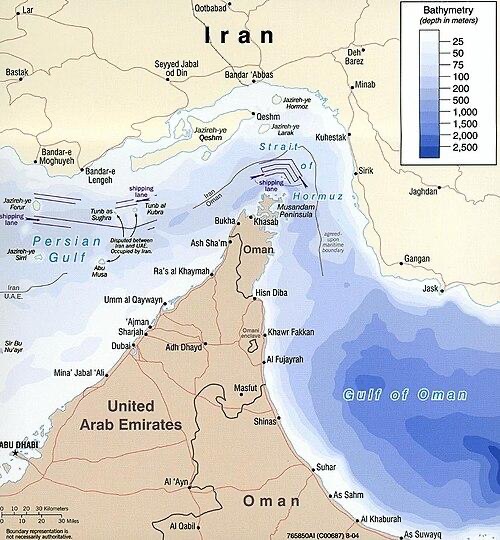
If any charge is to be put in place to ostensibly improve navigation, Iran will need the agreement of Oman (and likely the UAE, which borders the Strait either side of Oman). (See map below.) If Oman does not agree, ships will most likely choose to traverse the Omani side of the Strait so as to avoid the charges.
Even if Iran and Oman reach agreement to charge for navigational aids, agreement is still required from user states. Such agreement would normally be secured through discussions at the International Maritime Organization, as occurs in the adoption of Traffic Separation Schemes. Whether such agreement could be secured is by no means certain.
In the event that Iran and Oman agree to a system of charges on a bilateral basis and they effectively hamper passage through the Strait, there is little legal recourse against Iran because it is not a party to the UN Convention on the Law of the Sea.
Oman is, however. This would allow other states party to the Convention to challenge the charges before a court like the International Tribunal for the Law of the Sea. A judgment against Oman might force it to renegotiate any agreement with Iran.
However, none of these law of the sea rules might ultimately matter when you look at Point 14 of the MoU. That reads: “The final deal will be endorsed by a binding UNSC resolution.”
Under Article 103 of the UN Charter, a binding Security Council resolution prevails over other rules of international law. A peace agreement between Iran and the United States that allowed for some form of charge or toll could be included in this ‘final deal’ and adopted under Chapter VII of the UN Charter as a binding resolution. With the agreement of enough members of the Security Council to finally resolve this conflict, we could well see tolls or some other sort of fee imposed on shipping through the Strait of Hormuz in the future.
One advantage of this approach is that the precedential value of the new arrangement in the Strait of Hormuz would be limited to that Strait. The text of the UN Security Council resolution could be quite explicit that the peace agreement is without prejudice to existing rules of international law. States bordering the other major shipping chokepoints around the world—like the Singapore Straits, the Malacca Straits, or Bab el Mandab in the Red Sea—could not then follow suit.
Shipowners looking to move oil, gas, fertilisers and other goods through the Strait of Hormuz would have to absorb this new cost of doing business. Yet ultimately, we should expect that it will be the consumers who pay.
Professor Natalie Klein specialises in international law with a focus on the law of the sea. She is Associate Dean (Academic) and a Professor at UNSW Sydney’s Faculty of Law & Justice, Australia. Professor Klein is the former President of the Australian Branch of the International Law Association.