
Event Re-Cap: Developments in cyber and international law at the UN – Josephine Dooley

For the Australian National University’s Centre for International and Public Law (CIPL) Seminar in April, key members of Australia’s delegation to the United Nations (UN) Open-ended Working Group on developments in the field of information and telecommunications in the context of international security (OEWG) discussed latest developments in cyber and international law at the UN.

The third and final substantive OEWG session was held in March. Importantly, on 12 March 2021, 193 States adopted a consensus report containing recommendations to address cyber threats and ‘promote an open, secure, stable, accessible and peaceful’ international cyber environment (OEWG, Final Substantive Report UN Doc A/AC.290/2021/CRP.2, para 7 (‘OEWG Final Report’). The OEWG Final Report has now been endorsed by consensus by the UN General Assembly (UNGA). As part of that effort to improve peace and security in the cyber environment, the OEWG Final Report includes recommendations concerning the development of how international law applies in cyberspace, that States continue to:

  • Inform the UN Secretary-General, and through other appropriate avenues, of their national views and practices on how international law applies to states’ conduct in cyberspace  (Recommendation 38),
  • Support, in a neutral and objective manner, capacity-building of other States in developing their national views and practices, to contribute to building common understandings of and consensus on how international law applies in cyberspace (Recommendation 39), and
  • Participate in future UN processes on international law and cyber as a key step to clarify and further develop common understandings on the issue (Recommendation 40).

At the talk on 27 April 2021, participants were able to learn first-hand from key Australian representatives in the OEWG process what has been Australia’s role in the recognition and elaboration of the application of international law to cyberspace so far, and Australia’s perspective on the implications of the OEWG Final Report going forward. The Panel consisted of: 

  • Johanna Weaver, Special Adviser to Australia’s Cyber Ambassador and Head of Delegation on UN Cyber Processes,
  • Harry Aitken, Assistant Director, International Law Branch, Department of Foreign Affairs and Trade (DFAT),
  • Tess Kluckow, Senior Legal Officer, Office of International Law, Attorney-General’s Department (AGD), and 
  • Wing Commander Craig Deveney, Deputy Director, Operations and International Law Military Branch (Defence Legal).
Read More

Event: Book Launch of “The UN Commission on Human Rights: ‘A Very Great Enterprise'”, 2 June 2021

The UN Human Rights Council faces a critical phase in its development. Between 2021 and 2026, the Assembly is due to review its status, with a view to determining, to quote Kofi Annan at its inauguration in 2006, whether its work has “so clearly established [its] authority that there would be a general will to amend the Charter, and to elevate it to the status of a Principal Organ of the United Nations”.

A new book by former Secretary to the UN Commission on Human Rights John Pace is intended to aid the process of review by furnishing, in one volume, the entire record of the Commission and the Council since the inception of UN work in human rights in 1946. The UN Commission on Human Rights: ‘A Very Great Enterprise’ was published by Oxford University Press in 2020.

In the course of a career spanning more than 50 years in the field of human rights, John Pace has worked in a wide range of human rights activities at the international and regional level. He has headed several sectors of the human rights programme and was Secretary to the Commission on Human Rights (1978 to 1994) and Coordinator of the Vienna World Conference on Human Rights (1991 to 1993). He has a long association with UNSW, where he has taught and headed the Australian Centre for Human Rights in the early 2000s. He is currently Senior Visiting Fellow in the Faculty of Law and Justice and is a member of the Board of Directors of the Diplomacy Training Programme.

Former High Court Justice the Hon. Justice Michael Kirby AC CMG and Pro Vice-Chancellor Indigenous UNSW and Professor of Law Megan Davis will join the author in conversation about his new book, moderated by Director of the Australian Human Rights Institute Professor Justine Nolan.

This event will be held online on 2 June 2021 at 9:00 am to 10:00 am CEST. Registration for this event is via Eventbrite and is free to all attendees. Event attendees are eligible for a 30% discount on purchase of the book.

This event is co-hosted by the Australian Human Rights Institute and the International Law Association Australia.

COVAX, Global Health Governance and the Failure of Multilateralism – Rebecca Brown

The COVID-19 pandemic has been a breakpoint for global health governance, necessitating unprecedented cooperation worldwide. However, the success of global initiatives has been hampered by lack of state interest. This piece investigates why one such initiative, the COVID19 Vaccine Global Access Facility (COVAX), was abandoned by its high-income state supporters, setting out its vision, development and failings. In doing so, this piece seeks to outline issues within the Global North’s approach to multilateral health governance more broadly.

In July 2020, when the development of an effective vaccine against COVID-19 was in sight, assuring timely access to this vaccine became the essential instrument in the Global North’s political toolbox. The UK secured a ‘portfolio’ of vaccines through privately contracting with a number of pharmaceutical manufacturers, while Australian Prime Minister Scott Morrison announced an agreement with AstraZeneca, before this in fact had been finalised. Now, in May 2021, a 40-year-old may be vaccinated tomorrow, by the end of the year, in some years, or has already been vaccinated – depending on their country of residence. Such disparity in access to vaccines is often attributed to the inadequacy of governmental agreements with private companies. However, this analysis presupposes contemporary knowledge of which vaccines indeed proved effective, and glosses over broader issues of vaccine inequity entrenched by global power differentials and healthcare’s commercialisation. 

To that end, the COVID-19 Vaccine Global Access Facility (COVAX) appeared a promising solution. Initially floated at the extraordinary G20 meeting in March 2020, and launched by a number of state leaders the following month, COVAX swore to maximise access to vaccines, ensuring populations in all participant countries could soon receive a vaccine. Yet, COVAX remains underfunded, and vaccine nationalism – with states competing to secure doses from manufacturers – stymied its ability to acquire and distribute vaccines. COVAX, set out as a multilateral solution to the COVID-19 pandemic, has been reduced to a vessel for financial contributions to lower-income states; its failure represents a broader failure of collective action, and a continuation of neo-colonialist attitudes towards health governance.

Read More

Interview with Nicolás M. Perrone: Investment Treaties and the Legal Imagination – Part II: More than winning and losing

 In part I of this series, Dr Nicolás Perrone and ILA Reporter Assistant Editor Stephanie Triefus discussed the meaning of the legal imagination. This part elaborates on the content of Dr Perrone’s book and how and why the debate around how we talk about international investment law should evolve. 

ST: In your book you discuss the Philip Morris v Uruguay arbitration, which is similar to the claim brought against Australia by Philip Morris via the Australia-Hong Kong BIT. The current Australian government is not concerned about ISDS because Australia ‘won’ this arbitration, and so continues to favour ISDS in its review of its investment agreements. What does the reasoning in these awards tell us (or conceal) about how investment arbitrators conceive of the state’s right to regulate? 

NP: There is a document from the Cologne Society from around 1956 or 1957 that was submitted to the World Bank, that was saying that state regulation is very dangerous, and we should be careful about it. But then when more lawyers got involved, they were more nuanced, saying that of course the state needs to regulate, regulation is totally fine – the American Bar Association was saying that certain regulations are fine, but other regulations go too far. Something that they were very interested in back then was to make it impossible for Global South governments to expropriate when a provision prohibiting nationalisation was included in concession contracts. So they wanted to interpret a contract in a way that could trump states’ right to expropriate, even if that right was part of customary international law and enshrined in the General Assembly Resolution on Permanent Sovereignty over Natural Resources. So it’s not always obvious which regulation is the one that they want to prevent or make more difficult to implement. It depends on corporate needs, existing public policy and, of course, lawyers’ creativity.

Read More

Interview with Nicolás M. Perrone: Investment Treaties and the Legal Imagination – Part I: How we imagine international investment law

International investment law has been facing an increasing amount of negative publicity of late. Its detractors maintain that investment treaties constrain state regulatory space, affecting human rights and environmental measures, and exclude local communities from participating in decisions affecting them. On the other hand, proponents of investment treaties claim that they are necessary to facilitate development and that investment arbitration strikes a fair balance between investor rights and the public interest. In his monograph Investment Treaties and the Legal Imagination, recently published by Oxford University Press, Dr Nicolás Perrone contributes a historical perspective to this debate. Under the international investment law regime, foreign investors enjoy a privileged position; they have strongly enforceable rights, but no obligations. Perrone shows that the unusual status of foreign investors in international law is no accident, but rather the result of a “world-making project realized by a coalition of business leaders, bankers, and their lawyers in the 1950s and 1960s”. This world-making project, which is still alive and well in the legal imagination of investment lawmakers and practitioners today, maintains the power of corporate actors while silencing and making invisible those who are affected by investment projects.  

Dr Perrone is a Research Associate Professor at Universidad Andrés Bello, Chile, and has previously taught at Durham University and Universidad Externado de Colombia. Dr Perrone has been Visiting Professor at Universidad Nacional de San Martín, the International University College of Turin, and Università del Piemonte Orientale, a faculty member of the Institute for Global Law and Policy (Harvard Law School) and a Visiting Lecturer at Xi’an Jiaotong School of Law. Dr Perrone has also consulted for the OECD and worked as a legal fellow for UNCTAD. 

Dr Perrone joined Assistant Editor Stephanie Triefus for a conversation about his monograph and how academics and policymakers should reflect on the legal imagination of investment law as they engage in reform of the international investment law regime. 

Read More

Opportunity Lost: The ECtHR’s Restrictive Approach Re-ignites Vacuum between Human Rights and Humanitarian Law – Alessandro Silvestri

In Georgia v Russia (II), the European Court of Human Rights (‘ECtHR’ or ‘Court’) was asked to decide on numerous alleged breaches of human rights by the Russian Federation (‘Russia’) during a five-day armed conflict between Georgia and Russia. Despite the legal trend favouring the complementarity between International Human Rights Law (‘IHRL’) and International Humanitarian Law (‘IHL’), the Court ultimately held that Russia lacked jurisdiction over extraterritorial breaches of human rights under art 1 of the European Convention on Human Rights (‘ECHR’ or ‘Convention’), signalling a regrettable turnaround from recent case-law.

The ECtHR was handed the perfect opportunity to move past, as rightly underscored by Judge Chanturia, the legally ‘lifeless’ Bankovićdecision and enrich the interplay between IHRL and IHL in Georgia v Russia (II),but ultimately failed to do so. 

For legal purposes, the events under scrutiny may be divided in two parts. The first part concerned the armed conflict between Georgia and Russia, with South Ossetians and Abkhaz forces also playing an important role. Hostilities started on the night of 7 to 8 August 2008 and lasted for about five days, resulting in significant losses, including an alarming number of civilian casualties. Secondly, following a ceasefire, Georgia submitted that Russia perpetrated a number of human rights abuses, including the killings and displacement of civilians, the degrading treatment of civilians and prisoners of war, lootings and destruction of civilian objects, which would constitute significant violations of the ECHR. The scope of this written work is to assess the ECtHR’s approach to the first part and assess whether said approach adequately grasped the interplay between IHRL and IHL, as the latter comprises the body of international law applicable to armed conflicts.

The interplay between IHRL and IHL has been subject to much scrutiny in international law. It is internationally recognised that the two bodies of international law are mutually complementary, thus meaning that the protection of certain human rights, in particular, as the International Court of Justice in its Advisory Opinion on the Legality of the Threat or Use of Nuclear Weapons argued at § 25, the ‘right not arbitrarily to be deprived of one’s life’, does not cease during armed conflict (see also Orakhelashvili and the ICTY in Prosecutor v Kunarac et al§ 467). On the other hand, the ‘intricate legal issues of interplay that sometimes arise’ have arguably posed practical challenges in the way the interplay is to be understood, such as matters of derogation, jurisdiction, discretion, accountability, etc. (see also Bethlehem, 180– 82). The opportunity Georgia v Russia (II) presented for furthering the interpretation of applicable human rights norms in situations of armed conflict was therefore invaluable.

Read More

Call for Papers: iCourts (University of Copenhagen) Virtual Conference

The iCourts (University of Copenhagen) Virtual Conference will be occurring on 22 April 2021 and 23 April 2021. The Conference, organised by iCourts (the Danish National Research Foundation’s Centre of Excellence for International Courts), focuses on transforming evidence and proof in international criminal trials. As part of the Conference, a call for papers has been issued.

On 1 July 2022, the International Criminal Court (ICC) will mark the twentieth anniversary of the entry into force of the Rome Statute, its constitutive treaty. Prior to the Court’s establishment, and through those intervening years, scholars and practitioners have energetically debated the effectiveness of its procedural architecture, its evidential model, and its deliberations on matters of fact. The twentieth anniversary of the Rome Statute’s entry into force thus provides an opportune time to re-engage with these debates, and to take stock of a dynamic field which has undergone significant development. To this end iCourts is hosting a virtual conference, which will serve both to generate dialogue, and to facilitate engagement with innovative theoretical, and empirical work: research which advances the study of evidence and proof, shaping future practice, and laying the foundations for a dynamic research agenda.

iCourts welcomes contributions relating to the core topic of the ICC, and cognate international criminal courts and tribunals, but would also encourage submissions which engage with the overarching topics, as broadly construed. We particularly welcome papers focusing on national jurisdictional approaches to international offences, in addition to theoretical and empirical works whose application reaches beyond the sphere of international criminal adjudication. Contributions may include, but are not limited to, discussions of;

  • Proof and procedure in international criminal courts.
  • Open Source investigations and expert scientific evidence
  • Bayesian and Wigmorean inference networks
  • Evidential reasoning in epistemological and ontological perspective
  • Eyewitness testimony, narrative and memory
  • Innovative jurisdictional approaches to international crimes

We further welcome contributions from researchers, academics, and practitioners across the fields of law, the forensic sciences, political science, psychology, data science, and allied disciplines. Interdisciplinary approaches are particularly encouraged. Interested authors should send an abstract (300 words), and a brief author biography (150 words) to karen.richmond@jur.ku.dk by 29 March 2021. Authors will be notified of the status of their submission by 5 April 2021.

The organisers encourage contributors to submit their papers to a special issue of the International Criminal Law Review. Completed papers will be due by 14 June 2021, and will undergo blind peer review. Submissions must be original and should not have been previously published elsewhere. More details on the submission process will be provided following acceptance of proposals. For further information, please do not hesitate to contact the organisers.

Further details are available in the call for papers.

Post-mortem on the ICC’s Prosecutorial Election: Lessons Learned and Questions for the Future – Natalie Hodgson

On 12 February 2021, Karim Khan QC was elected as the third Prosecutor of the ICC. This piece revisits the long process to that election, focusing on two key issues: the role of the Committee for the Election of the Prosecutor and the need for consensus. The election brought to the fore multiple important issues for states, civil society, academics, lawyers and the Court to consider. Now that the election is over, it is important to take this opportunity to reflect on some of the lessons learned for the future. 

On 12 February 2021, Karim Khan QC, a barrister from the United Kingdom, was elected as the third Prosecutor of the ICC. The election process was long and fraught. This election was the first time that states parties did not elect the Prosecutor by consensus; four men were nominated to contest the final ballot. Only one of those nominees, Fergal Gaynor, was among the shortlisted candidates identified by the Committee for the Election of the Prosecutor (CEP). The other three nominees were drawn from the CEP’s longlist – Carlos Castresana Fernández, Francesco Lo Voi and Khan. 

The way the election ultimately unfolded was far from what was envisaged when the process to elect a new Prosecutor commenced in 2019. This piece focuses on two key issues that emerged during the election – the role of the CEP and the need for consensus. (Other issues that arose, such as the need for improved vetting of candidates and female underrepresentation among candidates, have been discussed elsewhere.) In reflecting on these issues, this piece hopes to identify some lessons and questions for future prosecutorial elections.

Read More

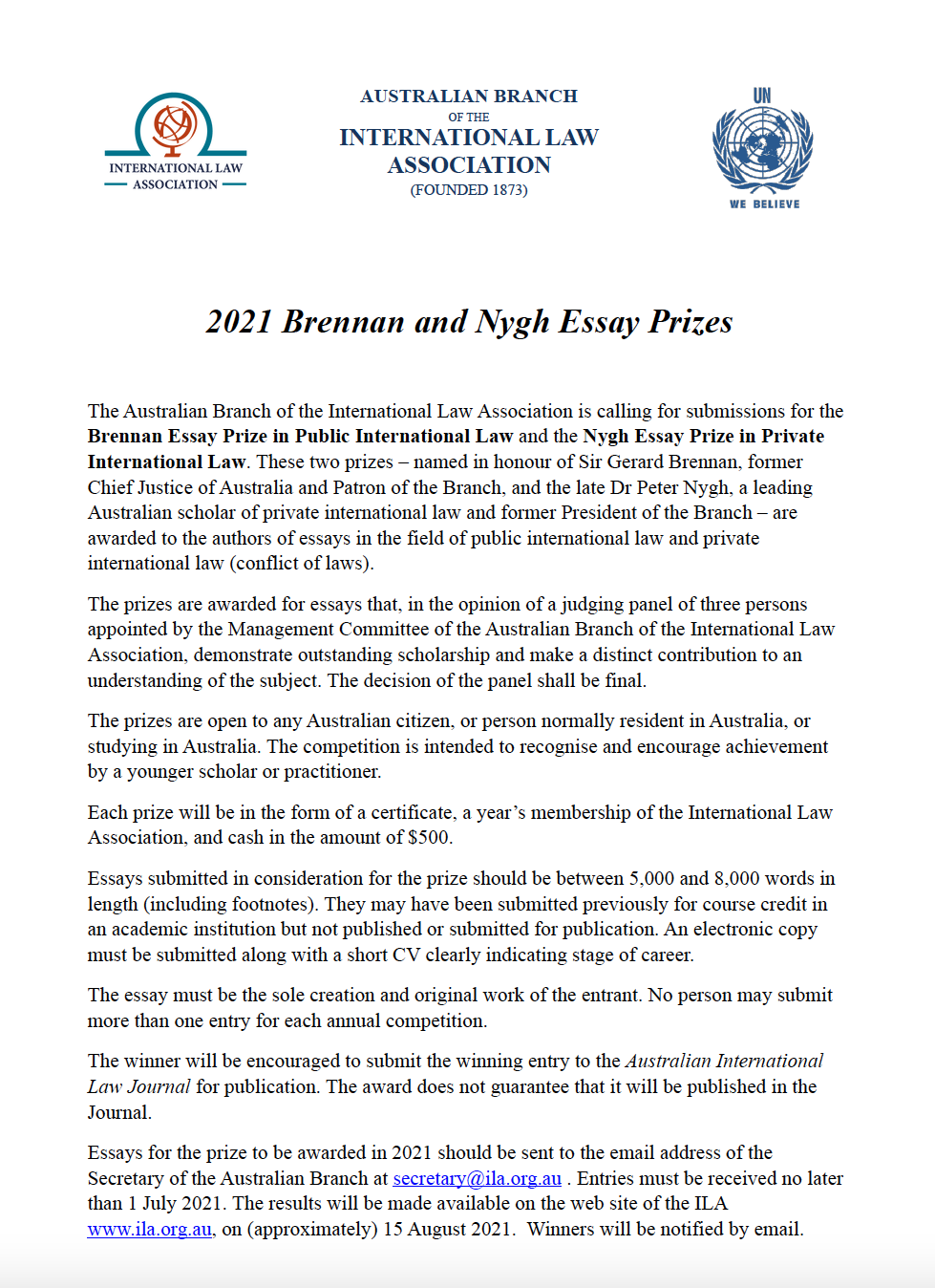
Call for Submissions: Brennan and Nygh Prizes

The ILA (Australia Branch) is calling for submissions for the Brennan Essay Prize in Public International Law and the Nygh Essay Prize in Private International Law.

The prizes are awarded for essays that demonstrate outstanding scholarship and make a distinct contribution to the field of public international law and private international law (conflict of laws), respectively. Submissions must be sent to secretary@ila.org.au by no later than 1 July 2021.

More details are available on the leaflet below.

A Review of the Malabo Protocol on the Statute of the African Court of Justice and Human Rights – Part II: Corporate Complicity in International Crimes – Jessie Chella

This is the second article in a two-part series examining the Malabo Protocol on the Statute of the African Court of Justice and Human Rights (ACJHR). When it comes into effect, the Malabo Protocol will empower the ACJHR to exercise jurisdiction over international crimes as well as introduce a regulatory scheme for corporate criminal liability. The first part of this series outlined the scope of the Court’s new jurisdiction with respect to international and transboundary offences. This second part explores the new corporate criminal liability provisions in more detail.

Traditionally, only natural persons could be prosecuted for the commission of international crimes in either domestic or international jurisdictions. Corporate criminal liability has been recognised in most domestic jurisdictions, but not under international criminal law. The ACJHR is set to change this with the introduction of Malabo Protocol provisions regarding the international criminal jurisdiction of the court (Article 28A), and a regulatory scheme for corporate criminal liability (Article 46C).

Read More